There was a discordant hum of human voices! There was a loud blast as of many trumpets! There was a harsh grating as of a thousand thunders! The fiery walls rushed back! and i fell into the pit and died.
p.s. sorry not very interesting but better than the original.
Wednesday, December 8, 2010

The First Snowfall
A romantic poem we read this week was called "The First Snowfall."It is really a captivating poem. It takes about a father mourning his dead daughter through his other daughter, and how the snow reminds him of her burial.It's really touching because he is taking something so pretty and it's bringing on memories and he's letting her know he still cares for her even though she isn't there with him. Poelpe saying losing a child is one of the worst things in the world and it makes since why he wrote of it. Romantic poems are used to write about personal things and nature and how it affects the writers life. Awesome poem!
my voki!
<script language="JavaScript" type="text/javascript" src="http://vhss-d.oddcast.com/voki_embed_functions.php%22%3E%3C/script%3E%3Cscript language="JavaScript" type="text/javascript">AC_Voki_Embed(200,267,"100992fe30980c6b2ab31d96e5692f6c",3157119, 1, "", 0);</script><BR><a href="http://www.voki.com/%22%3E%3Cb%3EGet a Voki now!</b></a><BR><BR>
McCarthy hearings
Cold War, April-June 1954
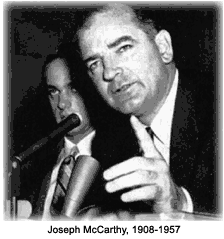
In the fall of 1953, McCarthy conducted an investigation of the Army Signal Corps. His announced intent was to locate an alleged espionage ring, but he turned up nothing. However, McCarthy’s treatment of General Ralph W. Zwicker during that investigation angered many. McCarthy insulted Zwicker's intelligence and commented that he was not fit to wear his uniform.
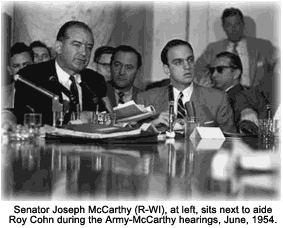
On March 9, 1954, CBS television broadcast Edward R. Murrow’s See It Now program, which was an attack on McCarthy and his methods. Subsequently, the Army released a report charging that McCarthy and his aide, Roy Cohn, had pressured the Army to give favored treatment to G. David Schine, a former McCarthy aide who had been drafted. McCarthy counter-charged that the Army was using Schine as a hostage to exert pressure on McCarthy not to expose communists within its ranks.
The Senate Permanent Subcommittee on Investigations decided to hold hearings that became known as the Army-McCarthy hearings, televised from the Senate Caucus Room. McCarthy relinquished his chairmanship position to Republican Karl Mundt from South Dakota so that the hearings could commence. Both sides of that dispute aired on national television between April 22 and June 17, 1954, for 188 hours of broadcast time in front of 22 million viewers. McCarthy’s frequent interruptions of the proceedings and his calls of "point of order" made him the object of ridicule, and his approval ratings in public opinion polls continued a sharp decline.

On June 9, the hearings reached their moment of greatest drama, when McCarthy attacked a young legal aide of Joseph Nye Welch (Army Chief Counsel). The aide, Fred Fisher, had once worked for the National Lawyers Guild (an organization with communist ties) and Welch had advised him to stay away from the hearings for his own good. Even though the man was not present, McCarthy impugned his character. Welch’s reply became famous: “Until this moment, senator, I think I never gauged your cruelty or recklessness .... Have you no sense of decency, sir, at long last? Have you left no sense of decency?” When McCarthy attempted to respond, Welsh cut him off demanding that the chairman call the next witness. Hesitating for a moment, the silent gallery broke into applause. McCarthy was stunned. The hearings drew to an inconclusive finish shortly afterwards.
Televised coverage of the hearings exposed McCarthy’s obnoxious demeanor did much to ruin his reputation, and later led to his censure by the U.S. Senate on December 2, 1954. His nasally “point of order” phrase became a national cliché and members of the subcommittee became household names and faces. The Army-McCarthy hearings live on in the memories of millions of Americans, aided by filmmaker Emile de Antonio’s documentary film Point of Order.
http://www.u-s-history.com/pages/h1769.html
The way i see McCarthy was just an all around bad man. He attacked innocent people. He coul not even gain the love of the people. All of his faults were caught on television and that is one of the reasons he will always be remembered. he accused espionage on the army and came up with nothing, except that during this process he treated many people badly including General Ralph W. Zwicker. He abused his power by saying who was "fit" to be in there. This angered me greatly.
Subscribe to:
Posts (Atom)